
Starlight Scope Myopia
Close Reading Yusef Komunyakaa's Poem Through a Military Lens

Dear Crew of the USS Tom Clancy,
If poetry analysis is a good enough passtime for James Angleton, it is good enough for us—though here at the Hunt for Tom Clancy we prefer to hillbilly fish with hook and marshmallow, so we’ll leave the fly fishing to others.
Hope you enjoy this dispatch, and don’t forget to become a paid subscriber. Big things coming this summer you’ll want to be around for.
Matt
Starlight Scope Myopia , a 1985 poem by Yusef Komunyakaa, is at the surface level a poem set in Vietnam. On this same level, it is spoken from the perspective of a soldier’s memory. The speaker is recalling his time as an unnamed rifleman set in on a reconnaissance mission near a bridge at night. The speaker views the world around him through a primitive and early version of night vision. Komunyakaa uses the language of light, darkness, technology enhanced lenses, and the multiple perspectives they provide as way of communicating not just the experience of the war, but the way that experience lingers in the form of traumatic memories from war (not necessarily his own, but representative of the experience of soldiers in the conflict)—and this is applicable to even the wars that followed the publication of the poem, not just the Vietnam war.


Starlight Scope Myopia is anything but myopic. The poem that transcends space and time, is broadly allusive, and touches not just on the experience of combat, but the trauma that experience produces, and the way that trauma effects and bends time for the participants.
All of the evidence for this argument is present from the poem’s title: Starlight Scope Myopia.
Webster’s defines Myopia as : a condition in which the visual images come to a focus in front of the retina of the eye resulting especially in defective vision of distant objects: nearsightedness
She wears glasses to correct her myopia. 2: a lack of foresight or discernment : a narrow view of something. The poem begins in media res with the speaker already looking through the scope at his targets. This is, in turn, a useful lens for the reader to understand the poem. The poem is constructed to both mirror and distort the experience of looking through the starlight scope for poetic effect.
The “Starlight Scope” Komunyakaa writes of is the AN/PVS-2A, which used a bit of radioactive material (Thorium-232) in the optical glass that magnified ambient light, and thus bore a radioactivity warning on the body of the instrument.
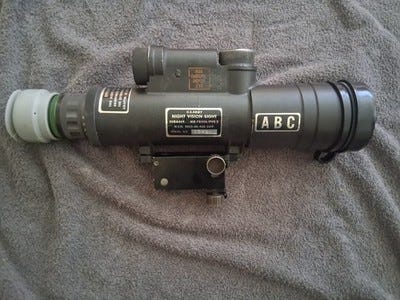
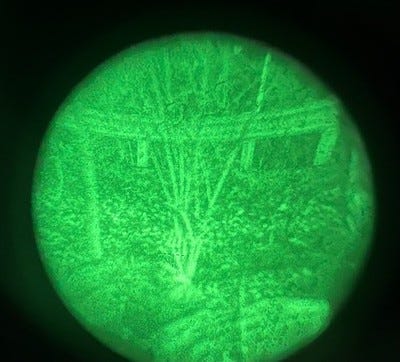
The Army describes the scope as “a portable, battery powered, electro-optical instrument used for passive visual observation and aimed fire of weapons at night. It uses the natural light (moonlight and/or starlight) of the night sky for target illumination,” according the Army’s technical manual for the scope. The operator flips a switch on the scope to turn it on. Afterwards a “green glow” image visible within the scope, which could be mounted to the top of a rifle or machine gun. (TM 11-5855-203-10 page 5)
The first line, however, reveals immediately that just as much more is going on in the darkness than can be seen with the naked eye, much more is going on underneath the surface of the poem, which opens this way:
Gray-blue shadows lift
Shadows onto an oxcart
Again, quoting from the Army’s manual for the scope is useful here to understand the nuance embedded within Komunyakaa’s poem. “When the power switch is turned on, the battery energizes the image intensifier assembly. The objective lens assembly, using the surrounding light of the night sky, focuses an image of the scene being viewed onto the front face of the image intensifier assembly.” (Ibid)
This phrase “focuses an image of the scene being viewed onto the front face of the image intensifier” is helpful for understanding the first two lines of Starlight Scope Myopia, as is the exhortation in the manual that the operator will know when the scope is on by the greenish glow from the lens. The reader of the poem is, in effect, mirroring the viewer in the starlight scope by viewing the scene Komunyakaa describes through three or four different lenses, depending on the mental equipment they bring to the poem.
For instance: the poem is dense with allusion rewarding for anyone with tacit knowledge or experience with anyone familiar with tactical matters or modern warfare. Mirroring the effect of the starlight scope lens in verse allows us to focus on different images at the same time, illuminating the darkness. Poetically and cleverly distorting the actual image the starlight scope would produce allows us to see the poet’s subtextual arguments. Evidence of this claim is present in those first two lines. The gray-blue shadows the poet describes would actually be green-gray through the lens of the starlight scope, but here Komunyakaa seeks to focus an image of the scene of American war in such a way that it evokes earlier American wars.
With this we get a sense of the poet’s ambition. This is not simply a Vietnam war poem. In the American Civil War of 1861-1865, Confederate Soldiers wore gray uniforms, while Union soldiers wore Blue uniforms. This imagery is projected on to the Viet Cong the speaker of the poem is observing, their shadows the color of Union and Confederate uniforms, blending together under the Vietnam Era starlight scope.
University of Houston professor Sunny Yang writes in African American Review that “Critics such as Angela M. Salas, Kevin Stein, and Daniel Cross Turner have noted that Komunyakaa super- imposes the South and its charged racial history onto Vietnam to reveal the fraught relations between black and white soldiers during the war.” The Gray-Blue shadows still lingering over America from the Civil War are now present in another Civil War, this one between South and North Vietnam. This places the African-American author of the poem in a strange position, empathetic to his enemy, indifferent to the reasons others have for him to kill them, but still a soldier who understands the mission. (Yang 80)
Making night work for us,
The starlight scope brings
Men into killing range.
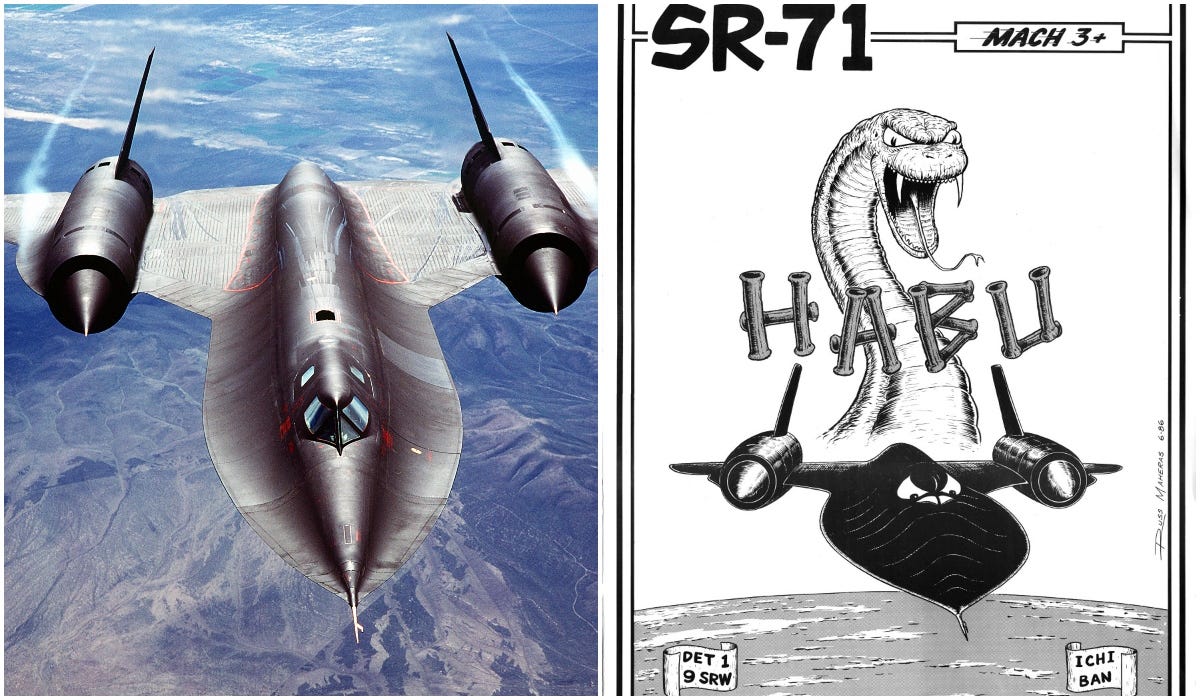
In these preceeding three lines, the poet cranks down to tight focus as to why they’re observing the oxcart and the shadows around it. The nuance of the oxcart imagery, so important to the poet that it is present in the first and last line of the poem, is also revealing. On one level an Oxcart is simply that, a cart pulled by a beast of burden, a wagon by another name. However, in the Vietnam War, the Americans had a different Oxcart, one that flew Mach 3 at 80,000 feet for the same purposes as the speaker of the poem: unobserved reconnaissance of the enemy.
The A-12 was a CIA reconnaissance plane created and built in extreme secrecy (“in the black” in American spy vernacular) by CIA and Lockheed to replace the U-2 spy plane. PROJECT OXCART, as it was known by the few people in the United States Government cleared for the classified information, intended to fill in the gaps in overhead imagery CIA couldn’t gather from space with the CORONA network of spy satellites. Oxcart went operational in 1965. CIA used six pilots and three A-12s based in Okinawa to fly 29 spy missions over Vietnam in OPERATION BLACK SHIELD from May 1967-May 1968.
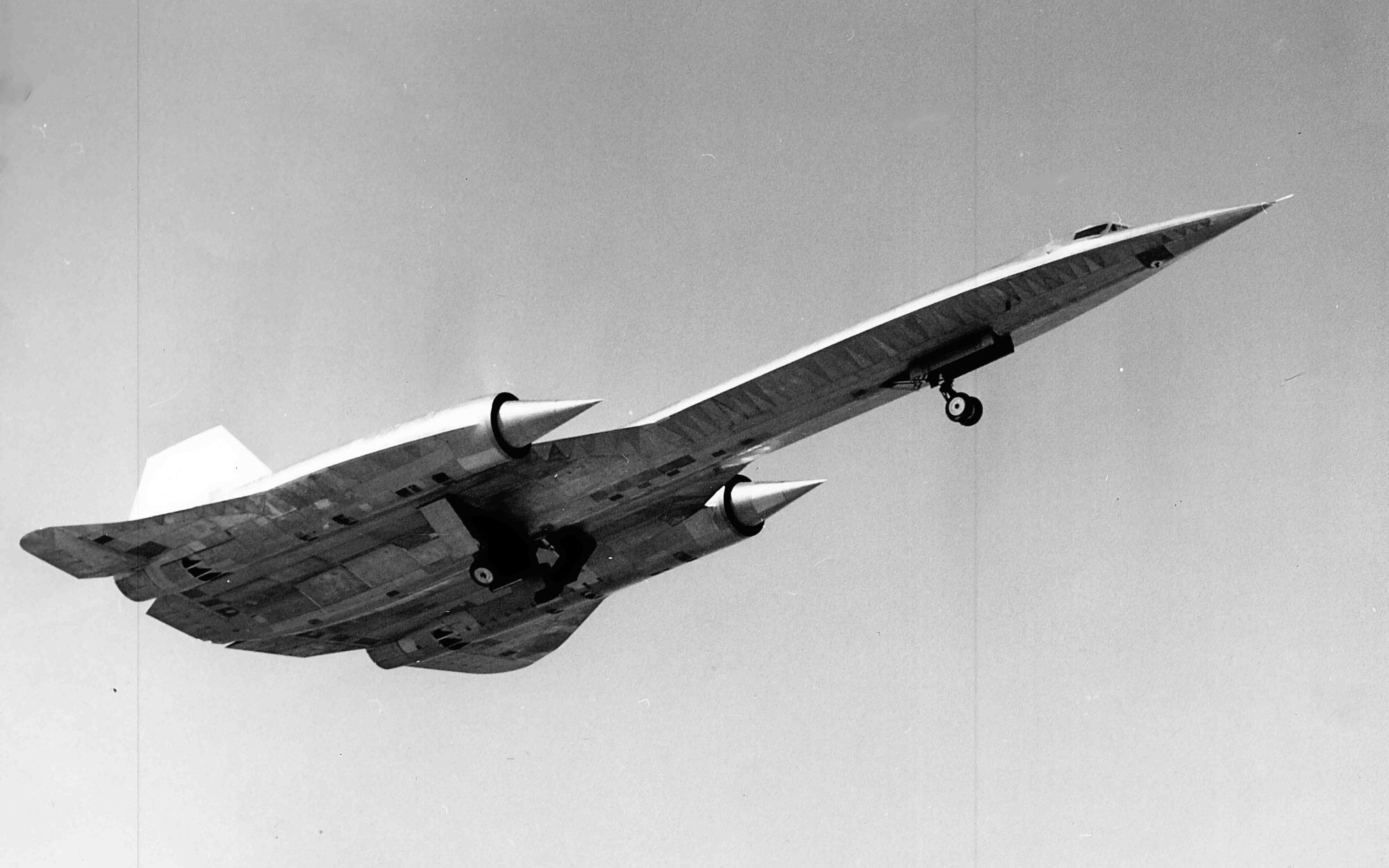
This Oxcart—the high flying spy plane that looked like a serpent and was called the Habu (a poisonous snake) by Okinawa natives—deployed on missions to Vietnam before Komunyakaa’s tour of duty there.
Komunyakaa served as a war correspondent—think Matthew Modine’s character in Full Metal Jacket—and later as an editor for the military newspaper Southern Cross from 1969-1970. During the time Komunyakaa was in country the war was at a critical juncture; there were protests and riots in the United States against the war so serious that Lyndon Johnson chose not run for President again. Johnson’s successor, President Richard Nixon, was exploring peace options with the North Vietnamese while also unleashing one of the most destructive bombing campaigns the world has ever known, OPERATION ROLLING THUNDER.
The river under the Vi Bridge
Takes the heart away
Like the Water God
Riding his Dragon.
Smoke-colored.
The Vi Bridge Komunyakaa references here has no direct corollary in Vietnam War history under that name; there’s a Y bridge that was critical in the battle of Hue, but that doesn’t match the other clues in the poem. Whatever bridge it is spans a river that “takes the heart away” which has multiple meanings; the line can be read that the river is so beautiful it takes the breath away, so horrible it removes one’s heart, or a reference to the river’s proximity to the North Vietnamese capital, Hanoi, water flowing from it would be flowing from the heart of the country, taking the heart away. We’re invited to explore multiple meanings in each line, but not commanded to. For instance, the poet’s use of the native Water God riding his dragon is a clue that the speaker is aware of the cultural context in which he fights, and our first indication that his feelings about all that are complicated and nuanced.
The bridge seems to fit the description of the Thanh Hóa Bridge in North Vietnam, a bridge that would’ve been at the forefront of any military man’s brain in the late 1960s. That bridge, originally built by the French and known by the Vietnamese by the name Hàm Rồng (Dragon’s Jaw), was destroyed by the Viet Minh in 1945, and rebuilt by the North Vietnamese from 1957-1964; Ho Chi Minh attended the bridge’s opening ceremony.
The bridge, which allowed both rail and vehicular traffic, was a critical logistical link for the North Vietnamese Army and their irregular guerrilla force in the South, known as the Viet Cong, during the Vietnam War. In 1965 President Lyndon Johnson added the bridge to the target list for aerial bombardment. In an article called “Breaking the Dragon’s Jaw,” Air Force writer Walter Boyne quotes a military history of the importance of the bridge in the conflict. “The apparent invincibility of the bridge; its cost in men, aircraft, and ordnance; its potential strategic importance; its symbolic value to the North Vietnamese—all served as an incentive for US aviators to find different techniques to destroy it.” (Boyne)
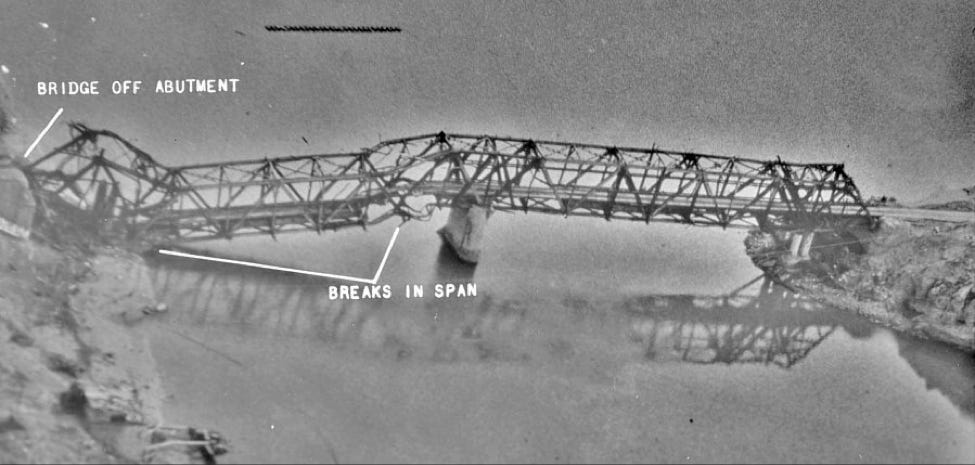
The late 1960’s bombing runs under OPERATION ROLLING THUNDER failed to destroy the bridge. In 1972, advances in what would later be called “smart bombs” (laser guided munitions) enabled the bridge to be taken out. This knowledge, once again, gives us a different perspective on the poem and its speaker. Read in this light, the speaker observing the Tranh Hóa Bridge, might be a commando on a mission deep behind enemy lines (the bridge was only seventy miles south of Hanoi). This Army scout would be holding not just the starlight scope for observation, but also a laser designator to “paint” the target for the bombing runs.
